
Back & spine
Back pain that has outlasted rest and therapy.
Lower back pain is not one condition. It is a symptom with roughly half a dozen common causes, and telling them apart is what decides whether treatment works.
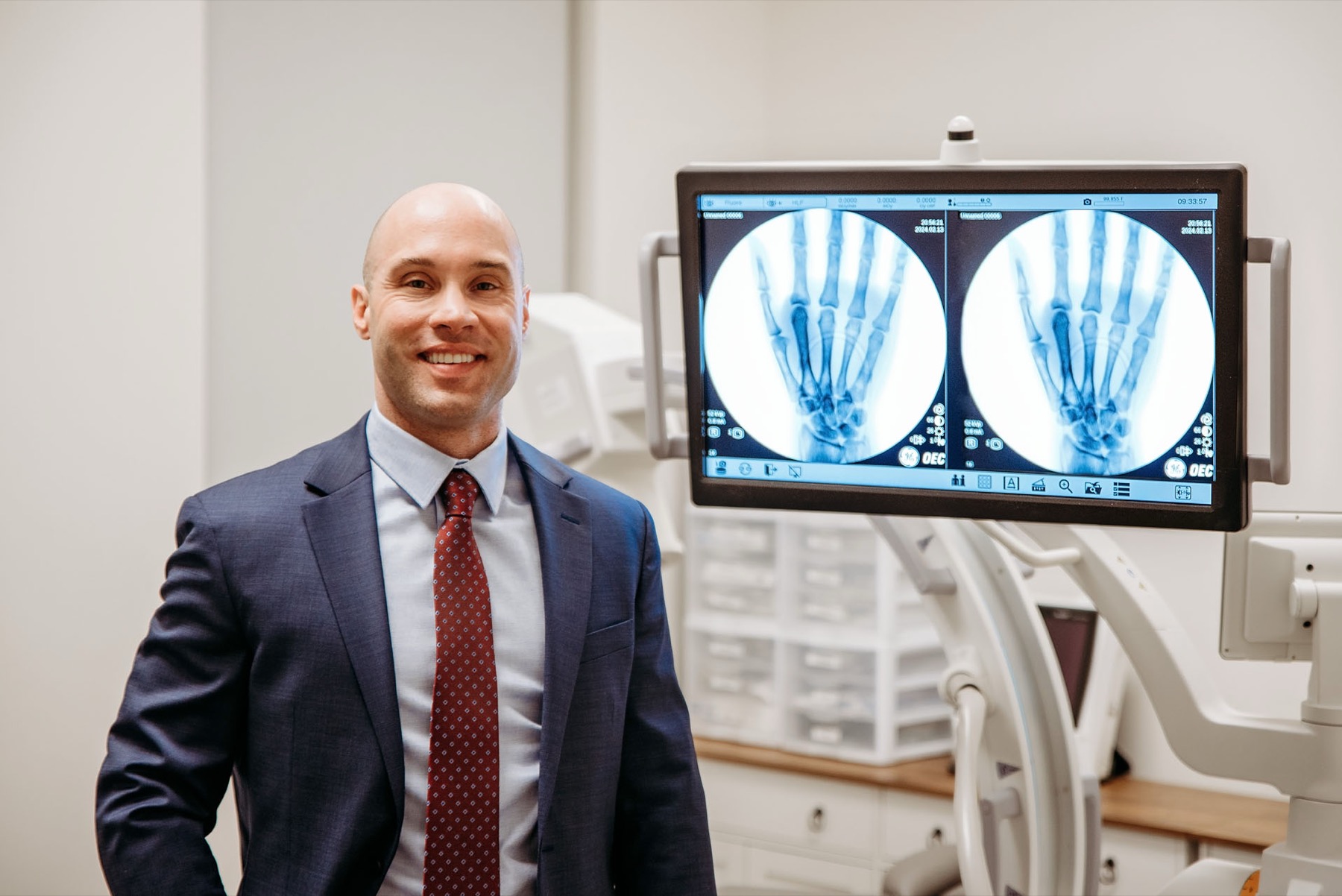
Where lower back pain actually comes from
Most persistent lower back pain traces to one of a handful of structures: the facet joints at the back of the spine, a disc, the sacroiliac joint where the spine meets the pelvis, a compressed nerve root, or the muscles and ligaments around all of it. They produce overlapping symptoms, which is why "lower back pain" on an MRI report rarely settles anything on its own.
Imaging finds abnormalities in plenty of people who feel nothing at all. A bulging disc on a scan is not proof it is the source of your pain. So the work is to connect what the images show to what your examination and your history show — and, where two explanations remain plausible, to test them.
What we see
The problems behind most back pain
- Facet joint arthritis — pain worse on standing, leaning back or turning
- Disc herniation or degeneration pressing on a nerve root
- Sacroiliac joint dysfunction — pain low and to one side, often mistaken for hip pain
- Spinal stenosis — worse walking, better leaning forward on a cart
- Spondylolisthesis, where one vertebra has slipped on the one below
- Pain that persists or returns after spine surgery
- Muscular and myofascial pain layered on top of any of the above
How it works
How we work out which one it is
-
01
Examination that reproduces it
Specific movements load specific structures. Which ones reproduce your pain narrows the list before any imaging is opened.
-
02
Your imaging, read with you
We look at your MRI or X-ray together and separate the findings that explain your symptoms from the incidental ones that do not.
-
03
A diagnostic block, where needed
Numbing a single joint or nerve under live X-ray answers the question directly. If the pain goes while the anaesthetic is working, we have found the source.
-
04
Treat what we confirmed
Injection, radiofrequency ablation, regenerative therapy or stimulation — chosen for the structure we identified, not for the region.
What we can do about it
Epidural steroid injection
For pain from a disc pressing on a nerve root. Delivered under live X-ray to the level involved.
Learn moreMedial branch block & radiofrequency ablation
Where facet joints are the source, blocks confirm it and ablation can quiet the nerves carrying that signal for months at a time.
Learn moreSacroiliac joint injection
Both diagnostic and therapeutic for SI joint pain, which is commonly missed.
Learn moreRegenerative therapy
PRP or bone marrow concentrate where the problem is a degenerative joint or ligament rather than nerve compression.
Learn moreSpinal cord stimulation
For pain that has not responded to anything else, including pain after previous back surgery.
Learn moreIn their words
Patients treated for this
Over too many years I have seen too pain management guys. This one is different. First, he caught something on an MRI that only one other health professional had caught, including those reading the MRI, a cyst at the base of my spine pushing again the nerve. Second, his (their) treatment of it was first class. He took his time, was gentle. Concerned about my pain level throughout the process. Talked. Was funny, or at least amused by my jokes, a nervous habit and caring. Great experience!
My first visit with the "Ponte Vedra Spine & Pain Center" was "exceptional". The staff were very friendly & welcoming as well as professional. My meeting with Dr Loch was equally "exceptional." He carefully reviewed the MRIs & and evaluations of previous physicians, listened attentively while I reported the origins of my back problem through my current condition. He then fully explained the available procedures to treat my back pain & was very frank about how effective each procedure could be in alleviating my pain. Our visit concluded with a thorough plan to address my condition until our next meeting; Dr Loch prescribed medication to manage my pain, and set up a follow up appointment. I could not be more impressed with the Spine & Pain Center and happier with my decision to seek treatment with Dr. Loch & staff. J. B. Egan CAPT. USCR Ret.
The Team at PV Spine and Pain have been great. From initial reach out through completion of procedure and communication has been top notch. Dr. Loch took time to discuss my needs, answered my questions and is unquestionably is an expert in his field. It is a friendly environment with the staff that clearly is concerned with the patient’s well-being.
No reviews mention that treatment yet.
Questions we get asked
I have had an MRI and was told it looks normal. Can you still help?
Do I have to try physical therapy first?
Will I need surgery?
How long does relief from an injection last?
Eliminate pain and reclaim your life.
Request an appointment with Dr. Loch, or call the office at (904) 750-3787. Most patients are seen within a week.