
Spine
Herniated and bulging discs.
A disc on a scan is not automatically the cause of your pain. Establishing whether it is changes what should be done about it.
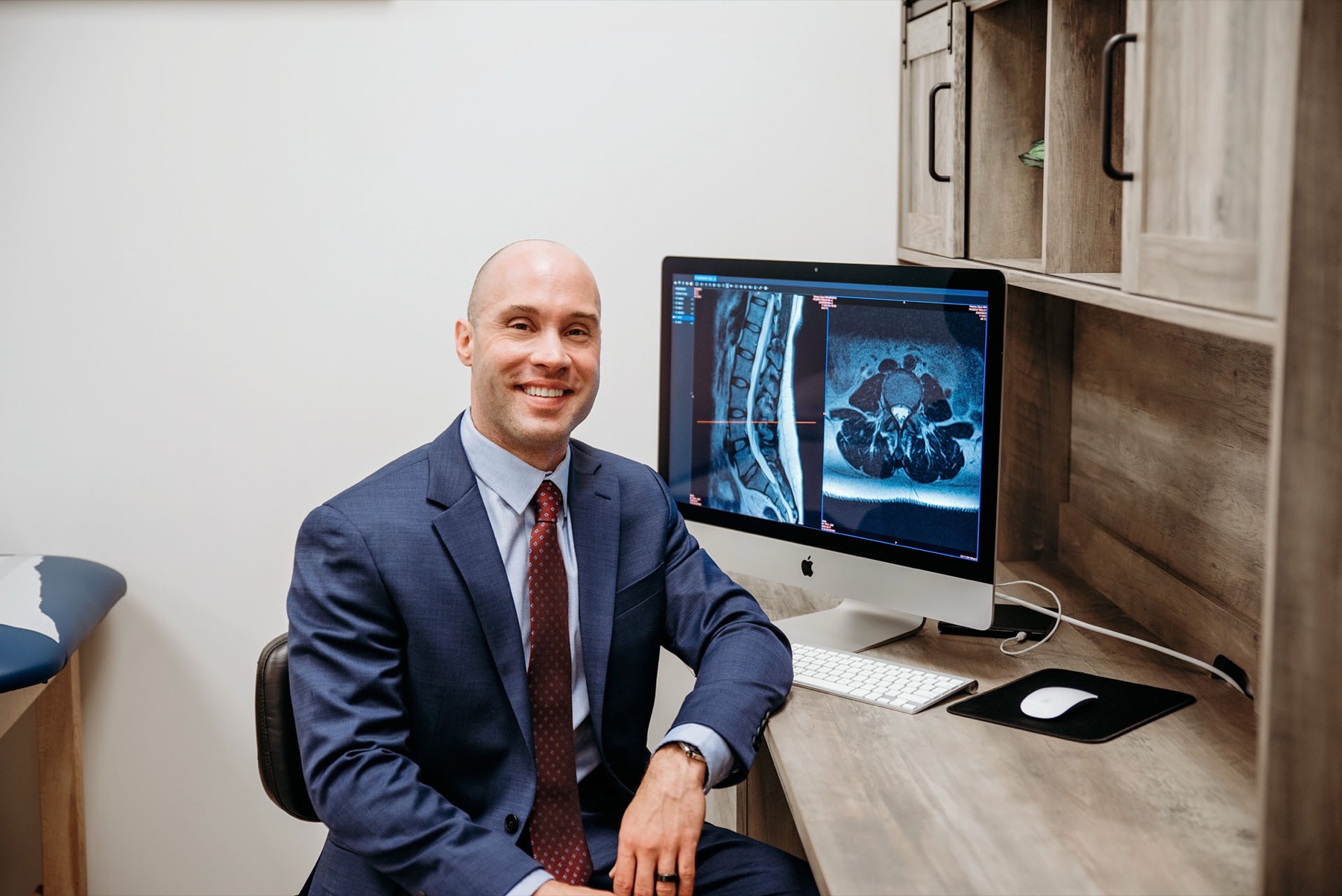
What a disc herniation is, and is not
Discs sit between the vertebrae and absorb load. When the tough outer ring weakens, the softer centre can push outward — a bulge — or through it entirely — a herniation. If that material contacts a nerve root, the result is pain, numbness or weakness travelling along that nerve.
Here is the part that matters: disc bulges are found routinely on the MRIs of people with no pain at all, and the proportion rises with age. A disc reported on your scan is a candidate explanation, not a verdict. Whether it is your explanation depends on whether the level it sits at matches the symptoms you actually have.
The other thing worth knowing: herniated discs often shrink on their own over months. Treatment is frequently about managing the inflammation and pain well enough to let that happen, rather than about removing the disc.
What we see
Signs a disc is genuinely involved
- Pain travelling along a specific nerve path, not just localised back pain
- Numbness or tingling in a defined band of skin
- Weakness in muscles supplied by that nerve root
- Pain worse with sitting, bending forward, coughing or sneezing
- Symptoms matching the level shown on imaging
How it works
How we handle it
-
01
Match symptoms to level
Your examination should predict what the MRI shows. When it does, the diagnosis is solid. When it does not, we keep looking.
-
02
Manage the inflammation
Much of the pain of a herniation is chemical inflammation around the nerve, not just mechanical pressure — which is why targeted anti-inflammatory treatment can help substantially.
-
03
Buy time for healing
The aim is to control pain well enough for you to stay active while the herniation resorbs, which most do.
-
04
Escalate only if needed
Progressive weakness or intractable pain despite proper treatment is when a surgical opinion is genuinely warranted. Most people never reach that point.
Treatment options
Epidural steroid injection
Anti-inflammatory medication delivered under live X-ray to the specific level and side involved.
Learn moreSelective nerve root block
Confirms the level responsible and often relieves the pain at the same time.
Learn moreRegenerative therapy
For contributing degenerative change in the surrounding structures.
Learn moreSpinal cord stimulation
For persistent nerve pain, including after previous disc surgery.
Learn moreIn their words
Patients treated for this
Over too many years I have seen too pain management guys. This one is different. First, he caught something on an MRI that only one other health professional had caught, including those reading the MRI, a cyst at the base of my spine pushing again the nerve. Second, his (their) treatment of it was first class. He took his time, was gentle. Concerned about my pain level throughout the process. Talked. Was funny, or at least amused by my jokes, a nervous habit and caring. Great experience!
My first visit with the "Ponte Vedra Spine & Pain Center" was "exceptional". The staff were very friendly & welcoming as well as professional. My meeting with Dr Loch was equally "exceptional." He carefully reviewed the MRIs & and evaluations of previous physicians, listened attentively while I reported the origins of my back problem through my current condition. He then fully explained the available procedures to treat my back pain & was very frank about how effective each procedure could be in alleviating my pain. Our visit concluded with a thorough plan to address my condition until our next meeting; Dr Loch prescribed medication to manage my pain, and set up a follow up appointment. I could not be more impressed with the Spine & Pain Center and happier with my decision to seek treatment with Dr. Loch & staff. J. B. Egan CAPT. USCR Ret.
The Team at PV Spine and Pain have been great. From initial reach out through completion of procedure and communication has been top notch. Dr. Loch took time to discuss my needs, answered my questions and is unquestionably is an expert in his field. It is a friendly environment with the staff that clearly is concerned with the patient’s well-being.
No reviews mention that treatment yet.
Questions we get asked
Can a herniated disc heal without surgery?
My MRI says degenerative disc disease. How bad is that?
Should I avoid lifting and exercise?
Eliminate pain and reclaim your life.
Request an appointment with Dr. Loch, or call the office at (904) 750-3787. Most patients are seen within a week.