
Treatments
Regenerative therapy, honestly framed.
Orthobiologic treatment uses your own platelets or bone marrow to target tendon, ligament and joint problems. It is genuinely useful for specific diagnoses — and oversold almost everywhere else.
What it is, and what it is not
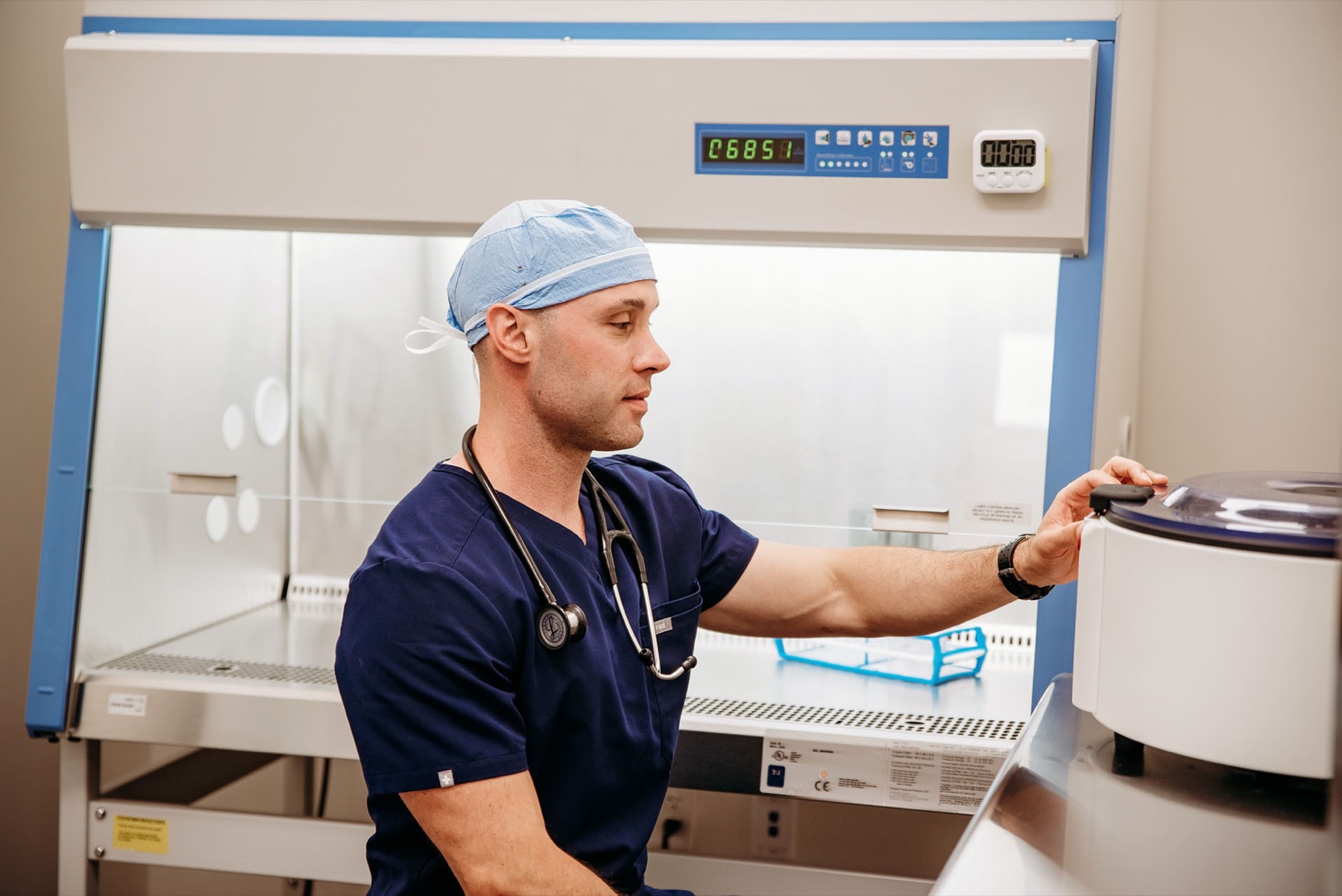
Platelet-rich plasma (PRP) is made from your own blood. A sample is drawn, spun in a centrifuge to concentrate the platelets, and the concentrate is injected under image guidance into the tendon, ligament or joint being treated. Platelets carry growth factors involved in tissue repair; the aim is to stimulate a healing response in tissue that has stalled.
Bone marrow concentrate is drawn from the pelvis and concentrated similarly. It contains a broader mix of cells and is used for problems where PRP is not expected to be enough.
Now the honest part. This is an area with a lot of marketing attached to it. The evidence is genuinely encouraging for certain conditions — tendinopathies, early-to-moderate knee osteoarthritis, some ligament injuries — and much thinner for others. It does not regrow cartilage. It does not make an advanced arthritic joint new. Anyone promising that is not describing the science.
Dr. Loch trained in orthobiologics through the Interventional Orthobiologics Foundation and is a member of the Regenexx physician network, which uses standardised protocols and tracks outcomes. He will tell you when regenerative therapy is a reasonable option for your problem, and when your money is better spent on something else.
Best candidates
Where this makes sense
- Chronic tendinopathy that has not responded to physical therapy — patellar, Achilles, gluteal, rotator cuff, tennis elbow
- Early to moderate osteoarthritis of the knee, hip or shoulder
- Partial-thickness tendon tears
- Ligament injuries that have healed poorly
- Patients who want to avoid repeated steroid injections into the same tendon
- Patients looking to delay a joint replacement, with realistic expectations about what that means
How it works
How a PRP treatment runs.
-
01
Draw
A blood sample is taken, much like any blood test.
-
02
Concentrate
The sample is processed in the office to separate and concentrate the platelet fraction. This happens while you wait.
-
03
Inject under guidance
The concentrate is placed precisely into the target tissue under ultrasound. Accuracy matters more here than with a steroid injection, because the material has to reach the tissue to act on it.
-
04
Recovery and rehabilitation
Expect some soreness for a few days — that inflammatory response is part of the mechanism, so anti-inflammatory medication is usually avoided. Improvement builds over weeks to months, and a graded loading programme afterwards makes a real difference to the result.
In their words
Patients treated with regenerative therapy
They are very friendly there. They made me feel very comfortable during my stem cell procedure. I have the utmost confidence in Dr Locke. This is the 2nd time of used him. I definitely recommend him.
Dr. Eli Loch has giving me a life without suffering and took me out of being debilitated. I was dragging my 🦵 leg and no other doctor could fixed my ankle that had been broken when i was younger. Now, i can step down on my ankle & lift my leg some. I am a Senior Citizen and worked as a laborer for years. It means a lot not to be in a Wheelchair. Try Stem Cells no matter who think you shouldn't. Enough said!!!
Dr. Loch and his staff are very professional and friendly. This was the second time I used Dr. Loch for PRP Treatment. Scheduling was very easy and my appointments were on-time with no delays. Dr. Loch's experience with up to date treatment allows patients to have procedures that are successful with little or no downtime. I drove three and a half hours to take advantage of the treatment he provides. I highly recommend Dr. Loch and his staff for treatment!
No reviews mention that treatment yet.
Common questions
Is PRP covered by insurance?
How long until I notice a difference?
How many treatments will I need?
Is this stem cell therapy?
Will it regrow my cartilage?
Eliminate pain and reclaim your life.
Request an appointment with Dr. Loch, or call the office at (904) 750-3787. Most patients are seen within a week.