
Knee
Knee pain, without going straight to replacement.
Osteoarthritis, meniscus problems and tendon pain each need different handling — including genicular artery embolization for arthritic knees that injections have stopped helping.
The gap this fills
There is a long stretch between "take an anti-inflammatory and lose some weight" and "you need a knee replacement". Many people spend years in it. That stretch is where interventional and regenerative options belong.
Knee osteoarthritis is the most common reason people come to us for a knee, but it is not the only one. Meniscus tears, patellar and quadriceps tendinopathy, bursitis and referred pain from the hip or lower back all present as knee pain, and a knee X-ray showing arthritis does not rule any of them out.
What we see
What we treat in the knee
- Osteoarthritis — stiffness in the morning, pain on stairs and after sitting
- Knee pain that injections used to help and no longer do
- Meniscus tears, including degenerative tears in older knees
- Patellar and quadriceps tendinopathy
- Pes anserine and prepatellar bursitis
- Knees that still hurt after arthroscopic surgery
- People who want to delay or avoid a knee replacement
How it works
How the knee gets assessed here
-
01
Dynamic ultrasound
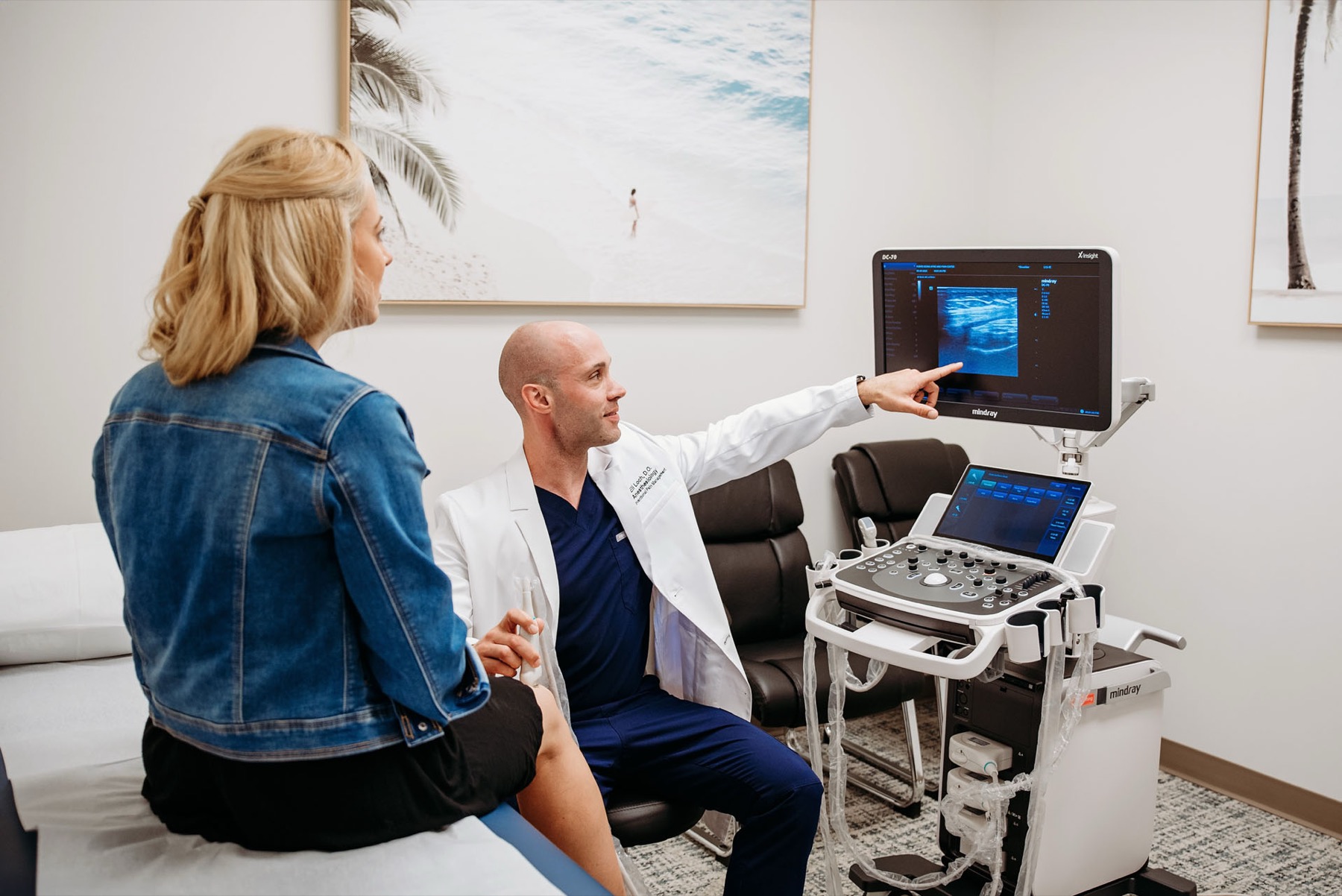
We watch the knee under load rather than judging it from a still image. Tendon and bursal problems in particular show themselves this way and are invisible on a standard X-ray.
-
02
Rule out referred pain
Hip arthritis and lumbar nerve root irritation both refer pain into the knee. Treating the knee for either is a wasted procedure.
-
03
Match the treatment to the tissue
Steroid, hyaluronic acid, PRP, shockwave and embolization each suit different problems. The diagnosis decides which.
-
04
Reassess honestly
If a treatment does not do what we expected, that is information about the diagnosis. We revisit it rather than repeating the same procedure.
Treatment options for the knee
Genicular artery embolization (GAE)
A minimally invasive procedure targeting the abnormal blood vessels that feed inflammation in an arthritic knee. An option for knee osteoarthritis that has stopped responding to injections, in patients not ready for replacement.
Learn moreUltrasound-guided knee injection
Steroid or hyaluronic acid placed accurately in the joint — guidance matters more in the knee than most people assume.
Learn moreGenicular nerve block & radiofrequency ablation
Quiets the nerves carrying pain from the knee joint. An option when the joint itself cannot be changed but the signal can.
Learn morePlatelet-rich plasma
For earlier-stage arthritis and tendon problems around the knee.
Learn moreSoftWave therapy
Non-invasive option for chronic patellar and quadriceps tendon pain.
Learn moreIn their words
Patients treated for this
Dr Loch studied the recent MRI of my knee and was able to give me details on the damage to my knee. He also had a plan to help me get some use without all the pain. So far so good.
From the initial call to make the appointment to speaking with Dr. Loch. We had a great conversation and am waiting for the order to get an MRI on my knee. It was a great first step to getting treatment on my knee.
Over a year ago, I received a PRP injection in my knee and the results have been outstanding. Dr. Loch and his team are exceptional—I couldn’t recommend them more highly. Thanks to their care, I’ve been able to return to all of my favorite sports and activities without limitation.
No reviews mention that treatment yet.
Questions we get asked
What is genicular artery embolization?
Will this let me avoid a knee replacement?
Is PRP better than a cortisone shot?
My knee X-ray shows bone on bone. Is there anything left to try?
Eliminate pain and reclaim your life.
Request an appointment with Dr. Loch, or call the office at (904) 750-3787. Most patients are seen within a week.